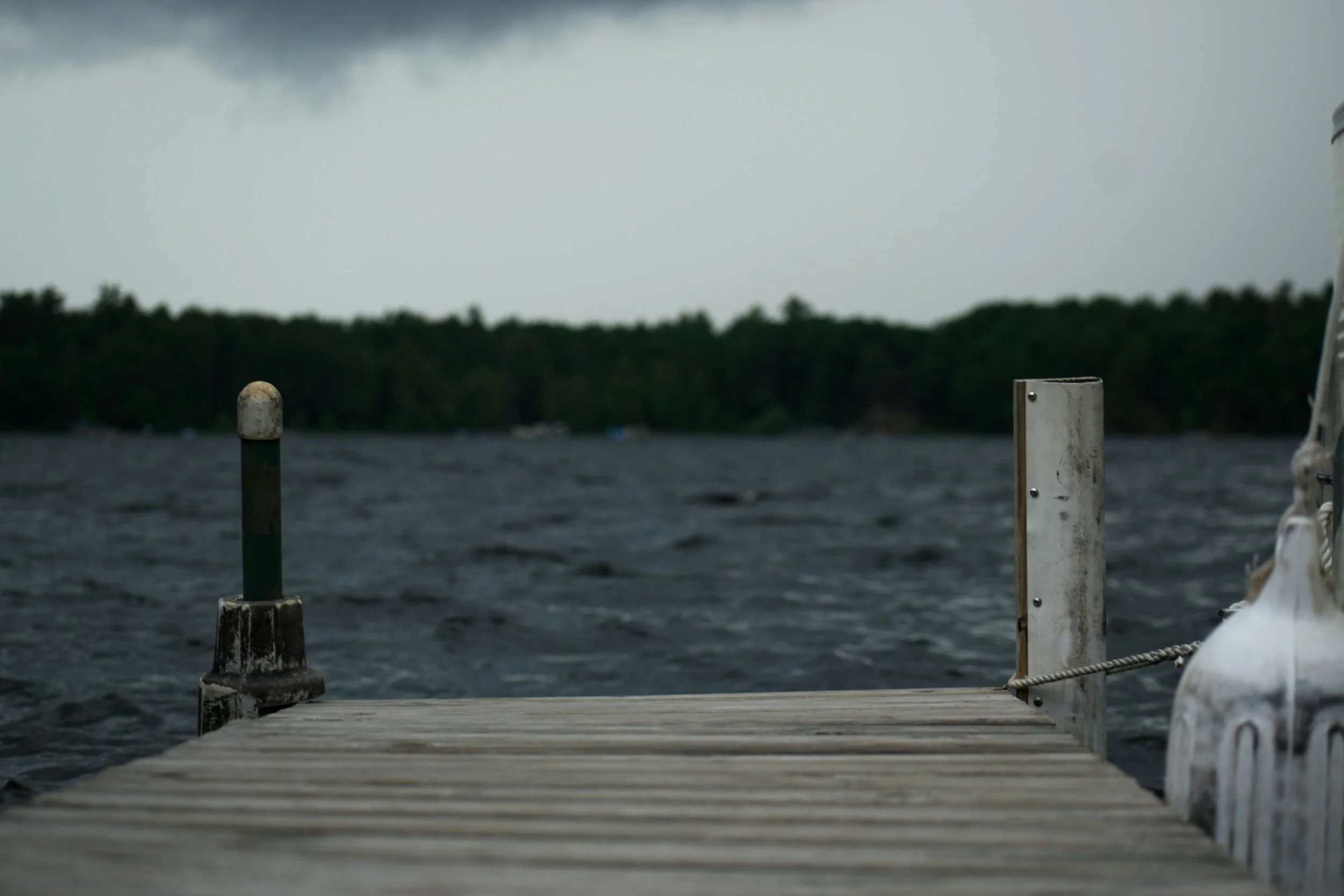
The storm was still on the other side of the ridge, but I could smell it.
Rain in the Pacific Northwest arrives before it shows up. It sends the smell ahead like a scout: wet cedar, cold stone, that metallic sweetness that sits at the back of your throat and makes the hair on your arms stand up for no reason you can name. I sat at the end of the dock with my jeans rolled to the knee, my feet in Merrin Lake, and a mug of coffee going cold beside my hip. I let the storm take its time.
The dock ran about forty feet out from shore, gray boards gone soft and silver with age, a few nails standing proud enough to catch a sock. Behind me, up a slope of salal and fern, sat the cabin. Sixty yards, maybe. One room, a woodstove, a bed that sagged in the middle like it was tired of holding people up. The listing had called it rustic. The listing had lied about the Wi-Fi.
To my left the shoreline curved away into reeds and a fallen alder, its roots clawing at the air like it had died mid-sentence. To my right, nothing but water and the gray hump of a boathouse nobody had used since the eighties. Straight ahead, a quarter mile across the lake, the forest stood up out of the water like a wall. Douglas fir, hemlock and cedar, packed so tight the dark between the trunks looked solid.
I came up here for a week alone. No phone signal, no plans, no one asking me what I was going to do next. The nearest human being was five miles back down the gravel road at Hadley’s Gas & Grocery, where the coffee was terrible and the corkboard by the door held a faded flyer: HAVE YOU SEEN DANIELLE? A smiling brunette in a graduation gown. Last seen swimming at Merrin Lake, August 14. Somebody had pinned a newer flyer for a lost beagle over the bottom half of her face.
The old man on the bench out front had told me, unprompted, not to swim after dark.
“Lake’s got manners,” he’d said, squinting at me from under a cap so faded I couldn’t tell what team it used to love. “But it’s got an appetite, too. You keep your side. It’ll keep its.”
I’d bought him a coffee. He held it in both hands the whole time we talked, and it never steamed. Not once. I’d watched the girl pour it fresh.
I’d decided not to think about that.
My mother would have loved this place. She was a lake person, the kind who swam until her lips went blue and then lied about being cold. The summer I was eleven, we spent a week on Flathead Lake in Montana, and she lost her ring out there. Thin silver, small green stone, her grandmother’s. She came up out of the water with her hand bare and her face gone white, and she dove for it until dark. She cried about it for a week and never mentioned it again.
She’s been gone six years. I still look at women’s hands in grocery store lines.
Now, with my feet going numb in the water, I watched the clouds roll over the ridge, heavy and bruise-colored, and thought this was the most peaceful I’d felt in a year.
That’s when something moved in the trees.
It wasn’t much. A shift in the dark between two trunks on the far shore, the way a shadow changes when someone steps through it. I leaned forward and squinted. The forest gave me nothing back. Fir, fir, darker fir.
A bear, I told myself. There are bears out here. Black bears, mostly, the kind that want your trail mix more than they want you. That was a perfectly reasonable explanation.
Except it had been tall. And bears, in my experience, don’t stand still that long.
I watched the spot until my eyes watered. Nothing. The wind picked up and pushed the first ripples across the lake toward me, and the water around my ankles went cold. Not lake-cold. Colder. Like something had opened a door at the bottom.
I didn’t pull my feet out. I’m stubborn like that. If the forest wanted to stare at me, it could stare.
Under the dock, they watched her feet.
There were four of them that afternoon, though the lake held more than four. They hung in the green dark beneath the boards where the light came down in stripes, and they watched the two pale shapes dangle and kick. Toes. Ten of them. One painted nail had chipped.
The oldest of them hovered closest. She was not large, no bigger than a child. From the waist down she was scale and fin, the long tail of something that had never needed a name from people. From the waist up she was all wrong in a way that would have made a person laugh before it made them scream: a wizened, grinning face, leathered and toothy, with long arms that ended in fingers far too clever for a fish.
Men had made copies of her kind once. They stitched the top half of a monkey to the back half of a fish, dried it until it grinned, and sold tickets. In 1842 a man named Barnum put one in a glass case and called it the Feejee Mermaid, and thousands of people paid to stare at a fake of the real thing.
She’d found that funny for a hundred and eighty-four years.
She drifted closer to the feet. She did not touch them. That was the rule, older than the dock, older than the cabin, older than the road out to Hadley’s. The shore belonged to the things in the trees. The water belonged to the lake. What walked on land was not theirs to take.
What came into the water, alone, was.
Last August, one had. The girl from the flyer had swum out past the boathouse at midnight on a dare from no one but herself. She’d been delicious. The oldest one still had her earring, a little gold hoop, tucked in the silt with the other pretty things.
So she only looked at this one. She breathed in the warmth coming off the girl’s skin, the smell of coffee and soap and a little fear, the good kind, the kind that keeps prey alive and interesting. Behind her the others drifted in a slow circle. Hungry, yes. Curious, more.
One of the younger ones, impatient, flicked his tail and sent a pulse of cold water up toward the boards.
The oldest bared her needle teeth at him. Manners.
Above them, the feet stayed in the water.
She liked this one. This one had something of hers.
The first drop of rain hit the back of my neck at a quarter to five.
I pulled my feet out, finally, and they came up white and pruned and aching. Something brushed my ankle on the way up. Soft, quick, there and gone.
A fish, I thought. Lakes have fish. That’s what lakes are for.
I gathered my mug, my book and the flannel I’d been sitting on, and walked the forty feet back to shore without running. The boards bounced under my steps. I did not look down at the gaps between them, at the black water slapping the pilings underneath. I’m not proud of a lot of things, but I was proud of that.
Halfway up the slope I stopped and turned around.
Across the lake, at the edge of the trees, something was standing.
It was too far away and the light was going, so I can only tell you what my eyes told me, and I’ve stopped trusting my eyes on that particular point. It was tall, taller than a man, and thin in a way that bothered me, all length and no width, like someone had taken a person and pulled. Something rose from its head that could have been branches behind it. Could have been antlers.
It wasn’t looking at me.
I know how that sounds. But I’ve worked jobs where you learn to read where people are looking, and that thing was looking past me, over my shoulder, down the slope at the dock. At the water.
At what was under the water.
The rain came down all at once, the way it does up here, like the sky had been holding it in out of politeness and finally gave up. The far shore vanished behind a gray curtain. When the curtain shifted, the treeline was empty.
A bear, I told myself again, with significantly less conviction.
Inside, I did what any reasonable woman does when the universe gets weird: I made soup.
Canned tomato, the kind with the red label that tastes like being eight years old and home sick from school. I lit the woodstove and turned on the battery radio, which only got one station, an oldies channel out of Aberdeen that faded in and out like it was haunted too. I ate standing at the window. The lake was a black sheet now, pocked with rain. The dock was a pale line pointing out into nothing.
I kept thinking about the old man. Keep your side.
I kept thinking about Danielle’s face under the beagle.
By nine I’d convinced myself it was nothing. By ten I’d read the same page of my book four times. By eleven I was in bed under two quilts, listening to the rain on the roof and a man on the radio singing about a girl he’d lost, and I was almost asleep.
That’s when I heard my name.
Not shouted. Called. Soft and clear and coming from the lake.
“Laney-bug.”
I sat up. The radio hissed. The stove ticked as it cooled.
Nobody has called me that in six years. Nobody alive knows to.
“Laney-bug, the water’s warm as bathwater. Cross my heart and hope to fly.”
Hope to fly. She always said it that way. She said “die” was bad luck, so she swapped it out, and it drove my father crazy for twenty-two years.
It was my mother’s voice. That’s the problem with the dead: they take everything with them but the sound of the way they said your name.
I want to tell you I stayed in bed.
I didn’t.
The rain had thinned to a cold drizzle by the time I reached the dock. I had the flashlight from the kitchen drawer, the yellow plastic kind that’s mostly battery, and I was wearing my boots unlaced and my flannel over my sleep shirt. I don’t remember deciding to go. I remember the boards under my feet, slick and bouncing. I remember the beam of the flashlight swinging over the water, picking out rain rings and nothing else.
“Mom?”
“Down here, baby.”
At the end of the dock I stopped and pointed the light straight down.
The water was moving. Not with the wind. Something under the surface was making slow, lazy circles, and in the flashlight beam I caught a flash of scale, then a pale glimmer like a hand turning over, then nothing.
“It’s warm,” my mother’s voice said, right below my feet. “I promise. Just put your feet back in. Just for a minute. Then come in all the way. I’ve missed you so much, Laney-bug.”
My boot slid forward. Just a little. Just to the edge.
“You’d be free game, you know.”
I nearly went in from the shock alone.
The old man from Hadley’s was standing on the dock behind me.
He was about ten feet back. Same faded cap, same canvas jacket, hands in his pockets. The rain was coming down on both of us, and he was perfectly, impossibly dry. In his left hand, held out to me like he’d come all this way to return it, was the coffee mug I’d had on the dock that afternoon.
I’d taken it inside. I’d washed it. It was sitting in the drying rack.
He held it out anyway.
“Lake’s got manners,” he said. “Told you. They won’t come up and get you. They’d never. But you walk in on your own, at night, with nobody watching?” He shrugged. “That’s just nature, sweetheart. Can’t hold a fish against being a fish. Ask the Danielle girl.”
Under the dock, my mother’s voice had gone quiet.
“How did you get here,” I said. It came out flat. Not a question. I was past questions.
He smiled. It was a nice smile, the kind you trust, which is exactly why you shouldn’t.
“Walked,” he said.
I looked past him, up the slope toward the cabin, and then across the lake. The rain had cleared enough to see the far shore. At the treeline, tall and pulled thin, something was standing again. Watching the water. Watching him.
He didn’t turn around. He didn’t need to.
“Go on back up to bed,” he said, and set the mug down on the boards between us, gentle as an offering. “Lock the door if it makes you feel better. It won’t matter, but folks like the sound of it.”
I went.
I did not look back.
I did lock the door.
In the morning the sky was scrubbed clean and pale and the lake was flat as glass. The mug was on the dock where he’d set it, full of rainwater. The one in the drying rack was gone.
There were tracks in the mud around the cabin.
They were pressed deep, longer than my forearm and narrow, split at the front like a deer’s. If a deer walked on two legs. If a deer were nine feet tall. They came out of the salal on the north side, circled the cabin twice and came right up to the bottom porch step.
Every time, they stopped at that step.
Every time, they turned and faced the lake.
I stood on the porch in my socks with a cup of instant coffee and looked at those tracks for a long time. Then I went inside and ate a granola bar, because apparently that’s who I am now.
I drove the five miles to Hadley’s because I needed real coffee, even bad coffee, and because I needed to see that bench.
It was empty.
Inside, Danielle was still smiling under the beagle. The girl at the register had a nose ring and the kind of eyeliner you can only pull off at nineteen. She rang up my coffee and a pack of jerky I didn’t want and looked at me like I’d been awake all night, which I had.
“The old man,” I said. “Usually sits out front. Faded cap. Do you know him?”
“Walt?” She didn’t even look up. “Sure. He’s around.”
“How long has he been around?”
She thought about it, popping her gum. “My granddad said he was around when he was a kid. Don’t ask him his last name, though. He gets weird about it.”
“What is he?”
She finally looked at me then, and for just a second her face did something careful. Then she shrugged.
“Tips well,” she said.
I stayed the rest of the week. I know. I’m stubborn like that.
I spent the afternoons on the dock in the daylight with my feet in the water and a fresh cup of coffee beside me, watching the treeline and never once seeing anything I could swear to. I went inside before dark every night. I didn’t hear my name again. Every morning there were new tracks around the cabin, and every morning they stopped at the bottom step.
I started leaving a cup of coffee on the porch rail at night. It seemed like the neighborly thing to do. It was always empty by morning.
On the last morning, I walked down to the end of the dock to say goodbye to the lake. Which I realize is a ridiculous thing to do. I did it anyway.
Sitting on the boards at the very end, right where my mug had been, was a ring.
Thin silver, worn smooth on the inside. A small green stone.
Flathead Lake is three states away. It doesn’t connect to Merrin. It doesn’t connect to anything.
The ring was dry. It was warm, like someone had been holding it.
I put it on. It fit.
I drove home with the windows down, smelling rain that hadn’t arrived yet, and I didn’t tell anyone.
Under the dock, the oldest of them watched the car’s dust settle over the gravel road and turned back toward the deep.
The ring had been a gift. Mostly.
The lake is never only one lake. All water is the same water, if you’re old enough and patient enough to swim it. She had carried that ring a long way, waiting for the right hand.
She was very good at waiting, and she knew the kind. The kind who sits at the edge with her feet in the water. The kind who answers when she’s called. The kind who says thank you for gifts.
And one day, alone, she would come all the way in.