Hecate: Threshold, Torchlight, and the Problem of Survival
Few figures in the ancient Mediterranean world stand so persistently at the threshold as Hecate [heh-kuh-tee].
She is neither among the Olympian sovereigns nor absent from their company. She does not command the sky, the sea, or the harvest in singular dominance. And yet from the earliest surviving Greek poetry onward, she appears with unusual authority — granted honor in heaven, on earth, and in the sea.
That authority is first preserved not in temple manuals or priestly instruction, but in verse.
The earliest extended literary witness to Hecate appears in Hesiod’s Theogony (c. 8th–7th century BCE), where she is described as uniquely honored by Zeus himself. This passage is striking for its expansiveness: unlike many deities whose roles are narrowly defined, Hecate is granted influence across domains and among mortals. Whether this reflects earlier cult prominence, poetic innovation, or regional theology remains debated. What is clear is that she enters the record already elevated.
She appears again in the Homeric Hymn to Demeter, not as a central protagonist, but as a witness — a torch-bearing presence at a moment of rupture. From this early association emerges a pattern: Hecate at the scene of transition. At abduction. At search. At revelation. She does not always initiate events. She stands where change unfolds.
Unlike figures whose literary footprint is vast and epic-driven, Hecate’s identity develops across centuries. Classical cult practice, Hellenistic expansion, Roman adaptation, late antique magical literature, and modern reinterpretation each contribute layers to her image. Torch-bearer. Crossroads guardian. Chthonic intermediary. Queen of ghosts. Patroness of magic.
But these identities do not arrive all at once.
To study Hecate responsibly requires resisting the urge to begin with her later reputation as “goddess of witchcraft.” That characterization belongs primarily to Hellenistic and Roman developments, amplified by late antique magical texts and further magnified in modern esoteric revival.
The earliest record presents something more complex — and less easily categorized.
Hecate emerges in archaic poetry as a liminal power granted unusual autonomy, later embodied in stone at crossroads, invoked in household ritual, and eventually drawn into the expanding cosmology of magic and the underworld.
Her survival is not singular.
It is stratified.
This article will move through those strata carefully: from archaic verse to cultic practice, from Anatolian questions to Roman transformations, from archaeological evidence to modern reconstruction. At each step, we distinguish what can be supported from what is inherited through interpretation.
Hecate stands at thresholds.
So does her record.

Twilight crossroads in the Greek countryside
The Name and Its Shadows
Before torches, before crossroads, before later grimoires place her among spirits of night — there is only the name.
Ἑκάτη — Hekátē.
It appears in Greek with no secure etymology and no clean linguistic ancestry. Unlike some deities whose names can be traced through Indo-European roots with relative confidence, Hecate resists that clarity. Scholars have proposed connections to Greek words meaning “far-reaching” or “worker from afar,” and some have suggested Anatolian parallels — particularly Carian or other southwestern Anatolian linguistic strata — yet none of these proposals command universal agreement.
What we are left with is absence of certainty.
That absence matters.
The lack of a secure Indo-European derivation has led some scholars to suggest that Hecate may not originate within the oldest layers of mainland Greek religion at all. Instead, her early prominence in regions of Asia Minor — especially in Caria — has encouraged the theory that her cult may have entered the Greek world through Anatolian channels before being fully integrated into Hellenic mythic structure.
The most frequently cited cult center supporting this hypothesis is Lagina in Caria, where Hecate was venerated in monumental form during the Hellenistic period. Yet even here, caution is necessary. The flourishing of a cult center in a given region does not automatically establish origin. It establishes importance.
What can be said with reasonable confidence is this:
By the archaic period, Hecate is fully present in Greek poetic tradition.
By the Classical period, she is embedded in civic and domestic ritual.
By the Hellenistic period, she is iconographically stabilized in triple form.
Her name does not betray her birthplace.
It does not anchor her securely to a proto-language.
It does not resolve whether she began as local Anatolian divinity later adopted into Greek myth, or as a Greek deity whose strongest cult expression flourished in Anatolia.
The record allows multiple models.
What it does not allow is simplification.
Linguistic Reach and Regional Question
In literary Greek, her name remains consistent: Hekátē. There are no dramatic shifts across dialects comparable to those seen in other divine names. This consistency suggests stabilization within Greek usage rather than ongoing linguistic transformation.
However, the relative silence of Mycenaean records — where many later Olympian deities appear in Linear B tablets — complicates the picture. Hecate does not appear clearly in surviving Mycenaean documentation. That silence does not prove absence, but it does limit claims of Bronze Age prominence within mainland Greek religion.
By the time Hesiod writes, she is already powerful. But the path between possible Bronze Age roots and archaic poetic elevation remains obscured.
The linguistic evidence leaves us in twilight.
Against Easy Conclusions
Etymological uncertainty invites invention.
Modern devotional and occult traditions often attribute symbolic meanings to her name — “she who works from afar,” “far-shooting one,” “the distant queen.” These interpretations may be poetically satisfying, but they are not philologically secure.
Where language does not give us clarity, we do not manufacture it.
Hecate’s identity, as preserved in the record, does not begin with a neatly translated root. It begins with appearance — in verse, in cult, in stone.
Her name is stable.
Its origin is not.
And that instability is part of her archive.
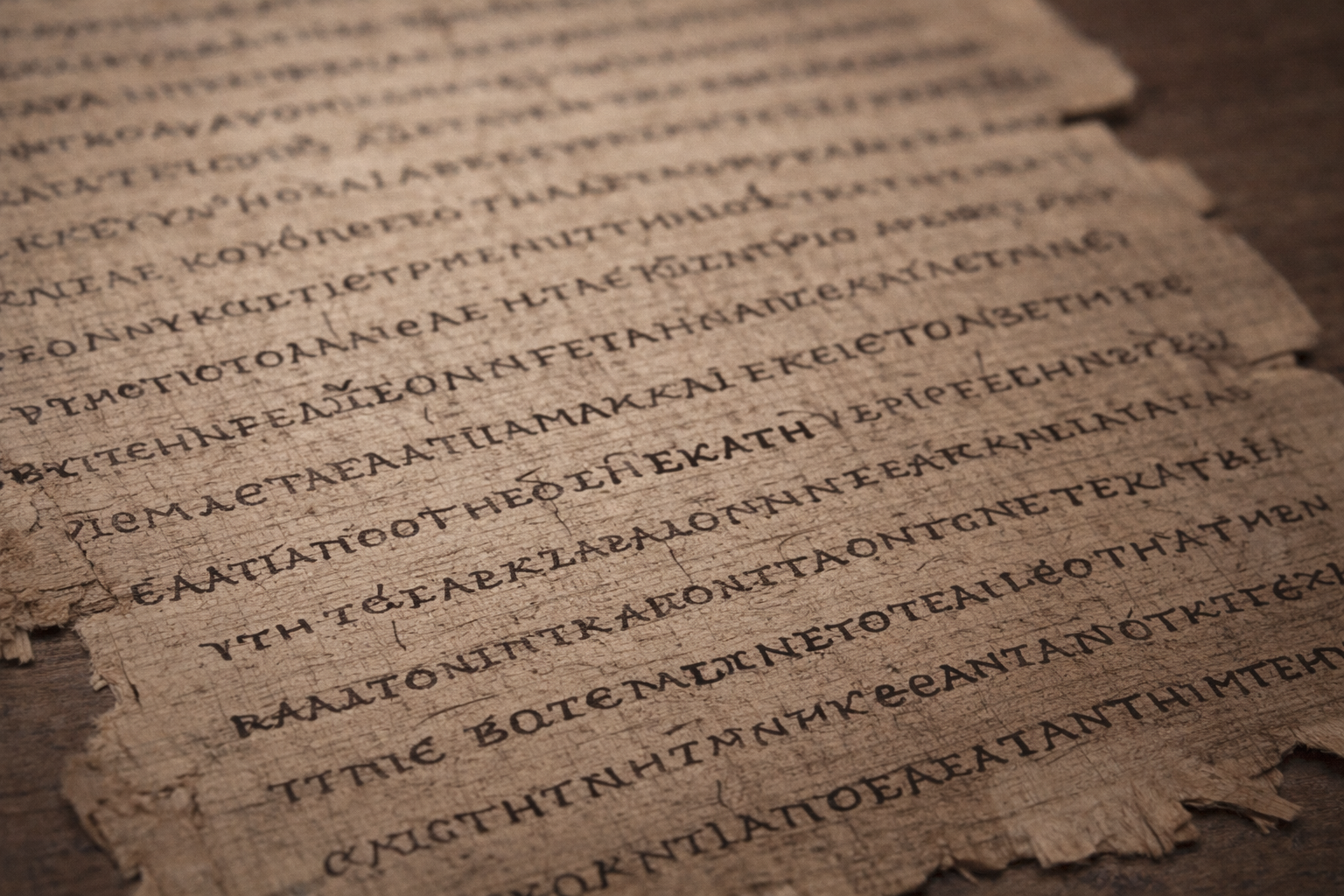
Ancient Greek papyrus with Hecate script
In the Earliest Poems
Before she stands at the crossroads in stone, Hecate stands in verse.
Her most substantial early appearance occurs in Hesiod’s Theogony (c. 8th–7th century BCE). Unlike many deities introduced briefly within genealogical catalogues, Hecate receives an unusually extended and emphatic passage. Hesiod describes her as honored above all by Zeus, granted authority across earth, sea, and sky, and empowered to bestow or withhold success among mortals.
This is not a marginal mention.
It is elevation.
Hesiod writes that Zeus did not strip her of former honors after the Titanomachy — a detail scholars continue to debate. Does this imply that Hecate belonged to an older divine order whose status required justification? Or is Hesiod constructing theological continuity for poetic coherence? The text does not resolve the question.
What it does show is this:
In archaic Greek poetry, Hecate is not yet reduced to the margins of night and ghost-lore. She is expansive. She grants prosperity, victory in games, abundance in fishing, and favor in assemblies. Her sphere is not narrowly chthonic. It is distributed.
This Hesiodic portrait complicates later assumptions.
Her next major literary appearance is in the Homeric Hymn to Demeter (likely 7th–6th century BCE). Here, Hecate’s role is quieter but symbolically potent. When Persephone is abducted, Hecate hears her cry. Later, she approaches Demeter bearing torches, offering knowledge, and eventually becomes attendant to Persephone in the underworld.
She does not cause the rupture.
She witnesses it.
She moves between worlds.
In this hymn, the pattern begins to clarify: Hecate is present at transition.
Torchlight becomes associated with her not through grand proclamation, but through narrative positioning. She stands at night. She bears flame. She mediates between mother and daughter, surface and depth.
The hymn does not yet portray her as queen of ghosts or sovereign of witchcraft. It portrays her as liminal companion — one who sees what others do not, who arrives where boundaries are crossed.
Beyond these two foundational texts, early references are scattered. She appears in Classical tragedy and lyric in passing invocations, often associated with night, crossroads, or underworld proximity — but rarely as central protagonist. The literary record suggests familiarity without dominance.
What emerges from the earliest poems is not a singular domain, but a pattern of adjacency.
Hecate stands beside thresholds — cosmic, civic, domestic.
She is not the storm.
She is the figure holding the torch when it breaks.
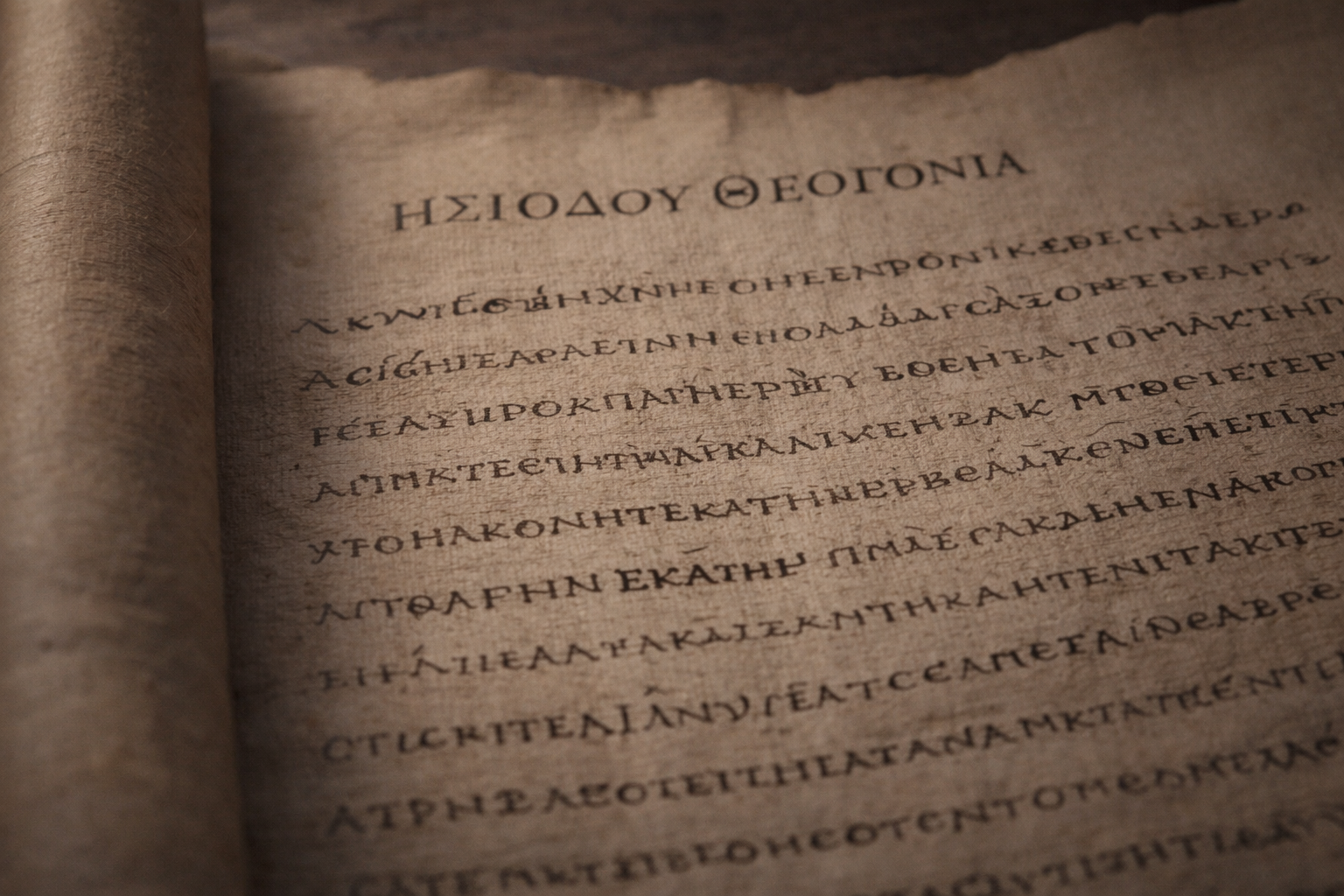
Ancient Greek manuscript with Hesiodic text
Powers at the Boundary
If the earliest poems introduce Hecate as elevated and present, later material clarifies where she stands: at edges.
Her domains, as supported by literary and archaeological evidence, cluster not around singular sovereignty, but around transition. To understand her properly, we must separate early attestations from later accretions and resist beginning with her modern reputation.
1) Liminal Space: Threshold and Crossroads
By the Classical period, Hecate is firmly associated with liminal geography — particularly crossroads (triodoi) and doorways. Small statues known as hekataia were placed at intersections and at the entrances of homes. These images often depicted her in triple form, facing outward in three directions.
This iconography does not originate in Hesiod. It emerges in cult practice.
Crossroads in the ancient Greek world were not merely navigational points. They were zones of uncertainty — places where offerings were left, where transitions occurred, where the living and unseen might intersect. To station Hecate there was not decorative. It was protective.
She becomes guardian of thresholds — spaces neither fully inside nor fully outside.
2) Torch-Bearer and Night Presence
The torch enters her iconography early through the Homeric Hymn to Demeter, but its significance deepens over time. In art and literature, Hecate is frequently depicted holding one or two torches, illuminating darkness.
Light in her case is not solar brilliance. It is directional flame.
She does not banish night. She navigates it.
The association with night grows stronger in later Classical and especially Hellenistic sources. Yet even in earlier contexts, her appearance at moments of darkness signals orientation rather than terror.
3) Protection and Household Rites
Despite later emphasis on underworld and ghosts, Hecate functioned within domestic cult practice. Offerings known as the Deipnon were left at crossroads or doorways, often at the new moon. These rites appear to have been apotropaic — intended to avert harm or restless forces.
This practice situates her not only in fear, but in maintenance.
She was invoked to guard boundaries, purify space, and oversee transitional moments within the household calendar.
4) Chthonic Expansion
By the Hellenistic and Roman periods, Hecate’s association with the underworld intensifies. She becomes linked with spirits, ghosts, necromantic rites, and magical papyri. In literary sources such as the Greek Magical Papyri, she is invoked in spells requiring authority over liminal or unseen forces.
This is a later layer.
The Hesiodic Hecate, honored across domains, does not appear primarily as queen of specters. The chthonic emphasis grows over time, shaped by evolving ritual, philosophy, and magical literature.

Hecate at the crossroads at twilight
5) Fertility and Prosperity — The Hesiodic Layer
It is easy to forget that in Hesiod, Hecate grants success in hunting, fishing, athletics, and assembly. She bestows increase and withholds it. This portrait complicates the narrower identity later attached to her.
The earliest record does not confine her to darkness.
It positions her as mediator of fortune.
The Thread Holding the Domains Together
Threshold. Torch. Crossroads. Protection. Underworld adjacency. Fortune granted or withheld.
These are not random attributes.
They converge around mediation.
Hecate stands where categories blur:
Day and night.
House and wilderness.
Life and death.
Divine and mortal.
Her power lies not in ruling a single sphere, but in governing passage between them.
Later centuries will emphasize certain aspects — magic, ghosts, chthonic sovereignty — sometimes at the expense of earlier breadth.
Responsible study keeps the layers visible.
She is not reducible to “goddess of witchcraft.”
She is guardian of boundaries — and boundaries shift.
Stone, Shrine, and Offering
If poetry establishes Hecate’s presence in language, stone establishes her presence in space.
By the Classical period, Hecate appears materially in the form of the hekataion — a three-bodied or three-faced statue placed at crossroads, gateways, and sometimes within domestic courtyards. These images often depict her standing back-to-back in triadic form, each figure oriented toward a different direction.
The triple form does not necessarily indicate three separate goddesses. It may represent spatial guardianship — omnidirectional vigilance at an intersection. Theological claims about triple divinity are later interpretive expansions; the archaeological evidence confirms repetition of form, not metaphysical doctrine.
These statues were not monumental in scale.
They were embedded in daily movement.
Placed at thresholds, they functioned as apotropaic markers — protective presences guarding liminal space.
The Deipnon and Ritual Practice
One of the clearest cultic practices associated with Hecate is the Deipnon, a monthly offering left at crossroads or doorways, often at the dark of the moon. Ancient sources indicate that food was deposited — sometimes as purification, sometimes as propitiation, sometimes as both.
The Deipnon appears to have functioned within a household cycle of cleansing and boundary maintenance. It was not an ecstatic rite. It was repetition.
Its location matters.
Crossroads are spaces of exposure. Offerings left there acknowledge vulnerability and seek regulation of unseen forces.
Hecate’s cult here is intimate, not imperial.
Lagina and Monumental Cult
While much of Hecate’s visible presence in Greece is modest and domestic, the sanctuary at Lagina in Caria presents a different scale. By the Hellenistic period, Lagina had become a significant cult center, complete with temple complex and civic festival.
This Anatolian prominence has fueled arguments regarding her origins. Whether Lagina represents birthplace or later flourishing remains debated. What is clear is that by this period, Hecate’s cult was fully institutionalized within regional political structures.
She moves from threshold statue to monumental sanctuary without abandoning her liminal associations.
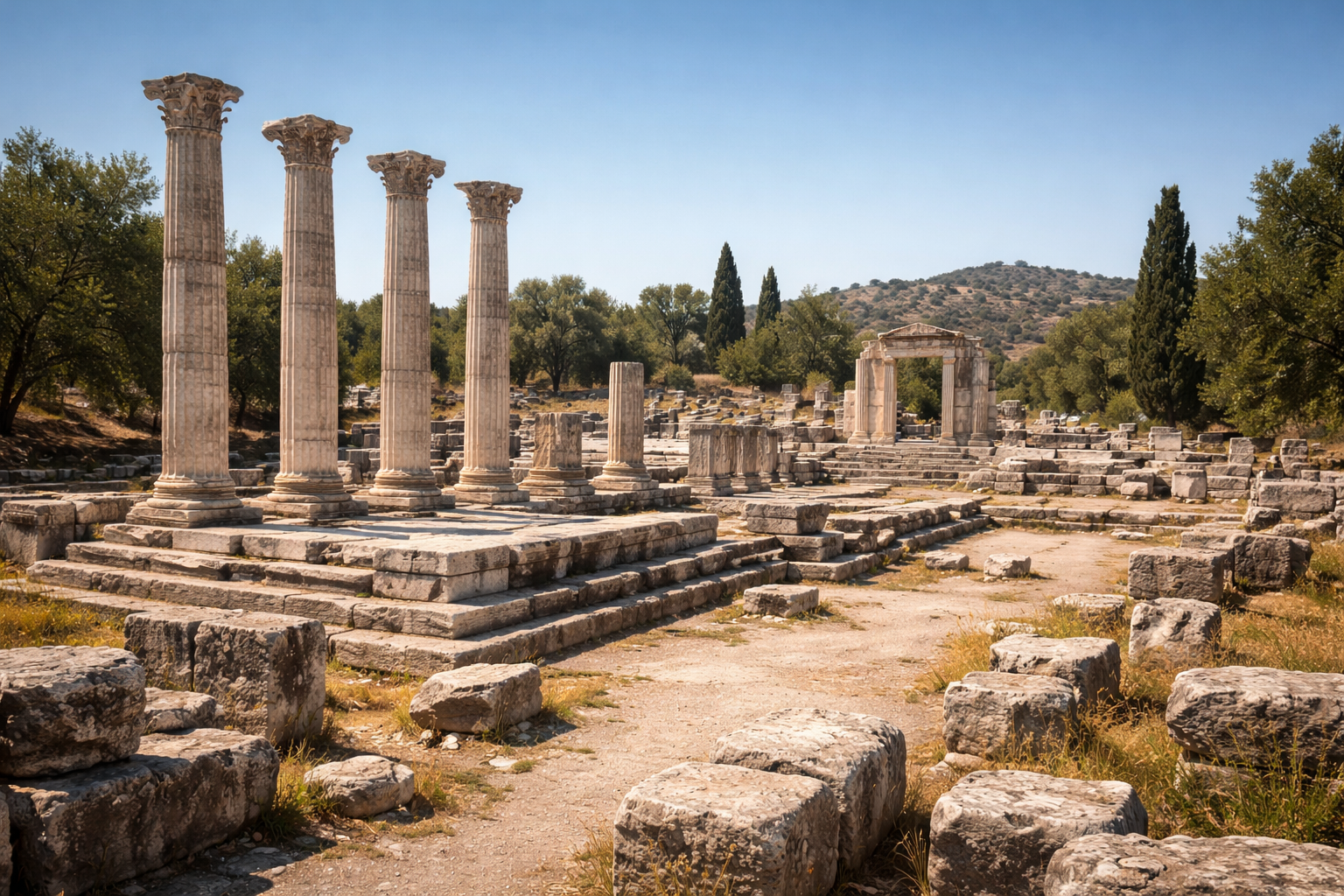
Ancient temple ruins under the sun
Inscriptions and Dedications
Epigraphic evidence confirms votive offerings and dedications to Hecate across the Greek world. Inscriptions often associate her with protection, guidance, and boundary oversight.
These inscriptions are concise. They do not provide theological treatises. But they anchor her cult materially across regions and centuries.
What the Material Record Suggests
Hecate’s archaeological presence reveals:
• Repeated association with thresholds
• Regularized offering practice
• Domestic and civic integration
• Regional cult centers
What it does not reveal is a centralized priesthood hierarchy or uniform doctrinal system. Her cult appears adaptable, embedded within both private and public spheres.
The stone record does not dramatize her.
It situates her.
At intersections.
At doors.
At the point where one thing becomes another.
And that is precisely where her power resides.
Supper at the Crossroads
If Hecate survives in stone, she also survives in repetition.
The Deipnon — the offering left at the dark of the moon — is one of the clearest windows into lived interaction with the goddess. Ancient sources describe food placed at crossroads or at the boundary of the household, often as part of a purification cycle marking the end of the lunar month. The practice appears both apotropaic and transitional: a clearing away of miasma, a recognition of unseen presence, a resetting of domestic order.
Importantly, the food was not always retrieved.
In some accounts, it was left deliberately — available to the poor, to animals, or symbolically to spirits. The ambiguity reinforces the liminal nature of the rite. It occupies the space between charity, purification, and propitiation.
This is not theatrical magic.
It is maintenance.
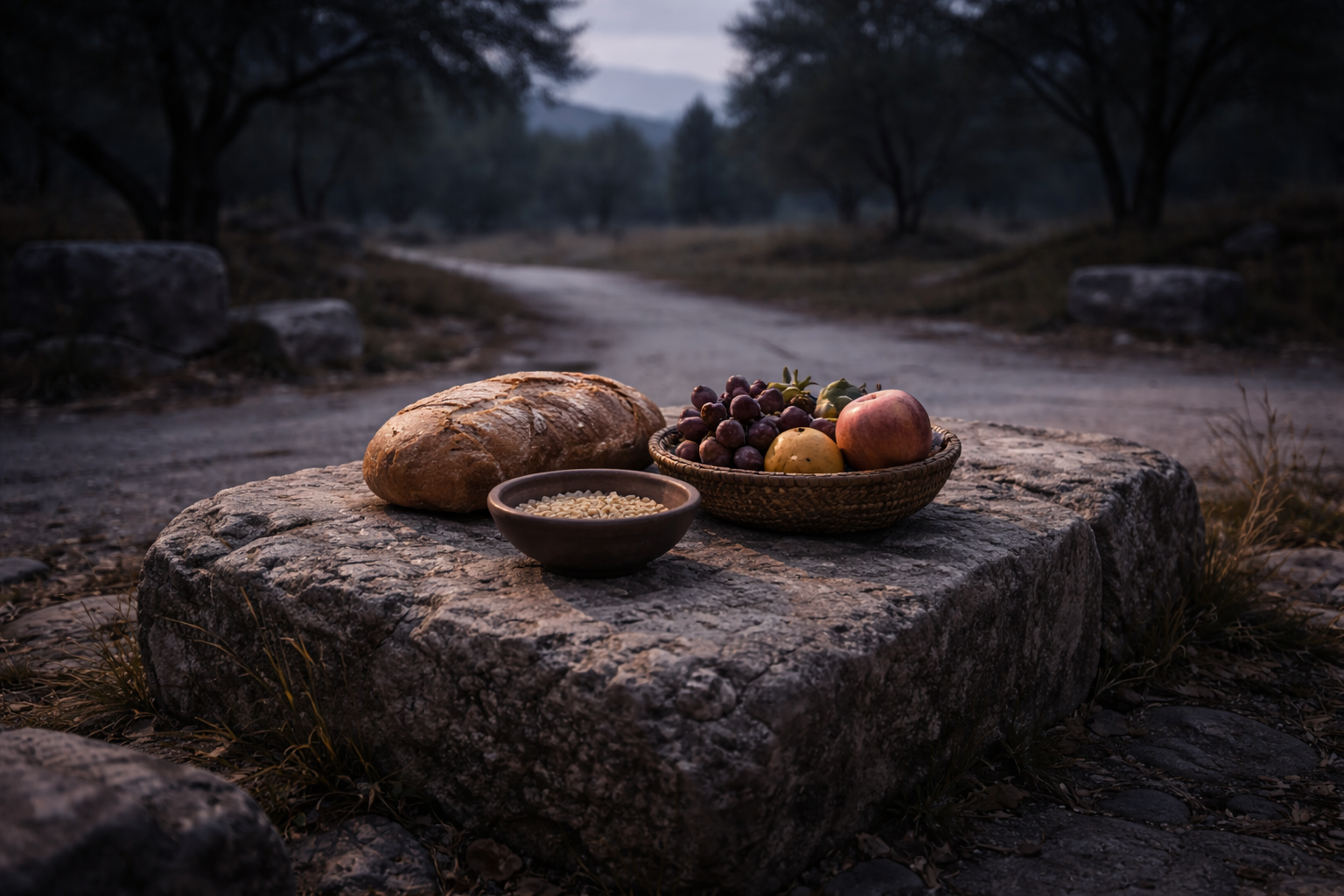
Twilight offering on weathered stone
Dogs, Sound, and the Night
By the Classical period, Hecate is increasingly associated with dogs — particularly their howling. Ancient writers note that dogs were thought to sense her approach. The connection may reflect threshold symbolism: dogs guard homes, mark boundaries, and respond to unseen disturbance.
The imagery intensifies over time.
In later literature, Hecate becomes more explicitly nocturnal and chthonic, accompanied by restless spirits and invoked in necromantic contexts. The Hellenistic period, especially, expands her association with the underworld and with magical ritual.
Yet this development is gradual.
The archaic Hecate of Hesiod, honored across sky and sea, does not yet preside primarily over ghosts. The torch-bearing mediator of the Homeric Hymn becomes, over centuries, the guide of shades.
The record does not show sudden transformation.
It shows accretion.
Roman Reframing
Under Roman adaptation, Hecate becomes increasingly entangled with underworld symbolism and magical invocation. Latin literature often amplifies her darker associations, linking her with night rituals and infernal spaces. Yet even here, she retains liminality more than dominion.
She stands at the boundary between upper and lower worlds.
Not fully sovereign of either.
The Shape of Survival
Unlike deities whose worship declines abruptly, Hecate’s presence shifts register.
From archaic hymn to Classical cult statue.
From domestic offering to Hellenistic magical papyrus.
From civic sanctuary to Roman poetic invocation.
She does not vanish.
She narrows and deepens.
The folkloric layer is thinner than that of later medieval European figures — there is no uninterrupted village cult carrying her through centuries unchanged. But elements of her practice — crossroads offerings, lunar timing, protective invocation — echo through later magical and esoteric traditions.
What persists is pattern.
Threshold.
Night.
Offering.
Transition.
The supper at the crossroads is not spectacle.
It is acknowledgment.
And in that acknowledgment, Hecate remains.
Torch in the Grimoires
By late antiquity, Hecate’s image shifts decisively toward the language of magic.
The Greek Magical Papyri (PGM), compiled between the 2nd century BCE and the 5th century CE, contain invocations to Hecate that position her as chthonic mediator, guide of spirits, and wielder of liminal authority. These texts often blend Greek, Egyptian, and Near Eastern elements, reflecting a cosmopolitan ritual environment rather than a purely Classical inheritance.
Here, her epithets multiply.
She is invoked at night, at crossroads, in rites requiring protection, revelation, or control over unseen forces. The tone is not civic. It is esoteric.
This is not the Hesiodic Hecate.
It is a Hellenistic synthesis — shaped by mystery religion, philosophical cosmology, and evolving magical practice.
The shift does not erase earlier layers.
It overlays them.
Late Antique Expansion
In later Neoplatonic philosophy, Hecate is sometimes positioned within elaborate metaphysical hierarchies. She becomes intermediary between realms, situated within structured cosmological systems that would have been foreign to archaic Greek religion.
These philosophical developments reinterpret her liminality as ontological structure — the boundary between intelligible and material worlds.
Again: this is a layer.
Not origin.
Renaissance and Early Modern Recasting
With the revival of classical texts in Renaissance Europe, Hecate re-enters learned discourse through translation and occult speculation. Early modern grimoires and demonological literature frequently cite her name in invocations associated with spirits and night rites.
The figure of Hecate becomes increasingly conflated with generalized notions of witchcraft. In some cases, she is reframed as infernal queen; in others, as pagan remnant absorbed into Christian demonology.
These portrayals reflect early modern anxieties as much as ancient theology.
They magnify her nocturnal and chthonic dimensions while neglecting her earlier civic and protective functions.
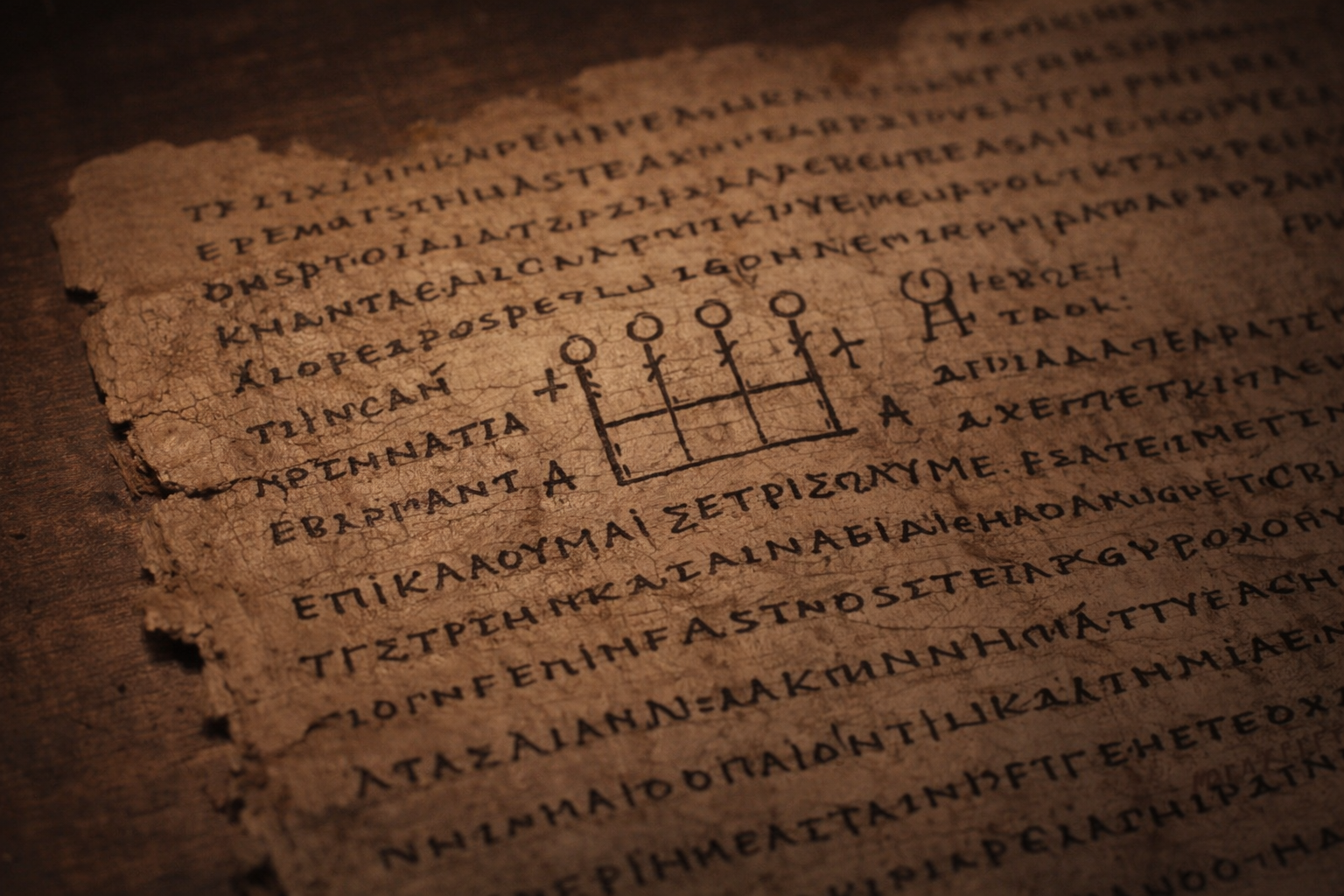
Ancient Greek magical papyrus fragment
Nineteenth-Century Romanticism
The Romantic movement’s fascination with the mysterious and the pre-Christian past further reshapes Hecate’s image. Poets and antiquarians draw upon classical references, emphasizing her torch, her dogs, her presence at the crossroads.
Here, aesthetic fascination begins to overshadow philological caution.
Hecate becomes mood.
Twentieth-Century Revival and Contemporary Witchcraft
Modern neopagan and witchcraft movements often reclaim Hecate as goddess of magic, witchcraft, and liminal feminine power. This identity draws heavily from Hellenistic magical texts and later occult tradition rather than solely from archaic Greek sources.
The distinction is not dismissal.
It is chronology.
Modern practice blends:
• Hesiodic authority
• Hellenistic magical language
• Roman poetic imagery
• Renaissance occult interpretation
• Contemporary symbolic frameworks
This synthesis produces a Hecate deeply resonant for modern practitioners — but layered.
To call this form “unchanged ancient worship” would collapse centuries of development.
To recognize it as reconstruction and reinterpretation preserves integrity.
Naming the Layers
Archaic Hecate: honored, expansive, multi-domain.
Classical Hecate: guardian of thresholds, recipient of Deipnon.
Hellenistic Hecate: chthonic and magical mediator.
Late Antique Hecate: cosmological intermediary.
Early Modern Hecate: occult and infernal symbol.
Modern Hecate: reclaimed patroness of witchcraft and liminality.
Each is real within its time.
None stands alone.
Her torch passes from text to shrine to papyrus to grimoire.
And with each handoff, the light changes color.
Where Scholars Disagree
Hecate’s record is not sparse — but it is stratified, and stratification invites argument.
Scholarly debate surrounding Hecate does not revolve around whether she existed in cult or text. It revolves around origin, development, and emphasis.
1) Anatolian Origin or Greek Development?
One of the longest-standing debates concerns whether Hecate originated in Anatolia and was later absorbed into Greek religion, or whether she was fully Greek from the beginning, with strong cult development in Anatolia emerging later.
The sanctuary at Lagina in Caria provides substantial evidence of Hecate’s prominence in Asia Minor during the Hellenistic period. The absence of clear Mycenaean references in Linear B tablets has been cited as suggestive of non-Mycenaean origin.
But silence is not proof.
It may indicate absence.
It may indicate preservation gaps.
It may indicate regional cult variation.
The evidence allows multiple models. It does not conclusively settle the question.
2) The Hesiodic Problem
In Hesiod’s Theogony, Hecate receives an unusually generous allotment of honors. Some scholars have proposed that this passage reflects regional bias — perhaps Hesiod elevating a locally significant goddess. Others argue it preserves an older stratum of cult importance later diminished.
Was Hecate once more central within Greek religion than later tradition suggests?
Or does Hesiod represent poetic inflation?
The text itself does not clarify.
3) The Triple Form: Theology or Function?
The triple-bodied hekataion statues are among the most recognizable features of Hecate’s cult. But what does the triadic form mean?
Interpretations include:
• Representation of three domains (sky, earth, underworld)
• Guardianship of three directions at crossroads
• Symbolic multiplicity without doctrinal intent
The archaeological evidence confirms repetition of triple form.
It does not confirm theological explanation.
Later esoteric traditions often read the triad as metaphysical doctrine. Classical evidence does not clearly support that claim.
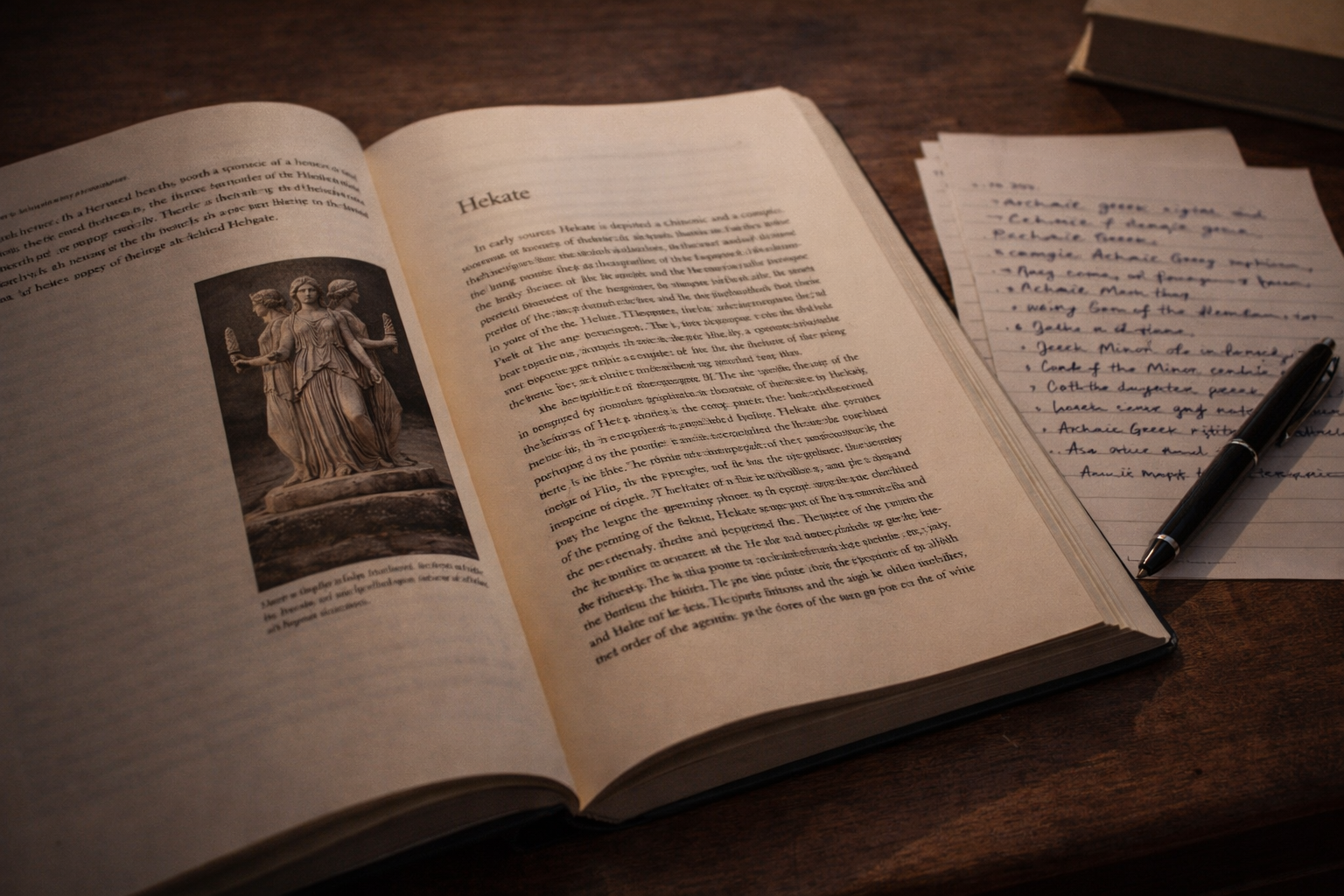
Exploring Hekate in Greek religion
4) When Does the Chthonic Emphasis Dominate?
Another debate concerns timing.
Was Hecate always primarily chthonic, or does that emphasis intensify in the Hellenistic period?
The Hesiodic portrayal is expansive and not primarily underworld-centered. The Homeric Hymn situates her at a transitional moment but does not define her as ruler of the dead.
By contrast, Hellenistic magical texts and later Roman literature foreground her underworld authority and nocturnal associations.
The shift appears gradual.
But scholars differ on how early that darker emphasis began.
5) Magic: Core Identity or Later Accretion?
Modern readers often begin with “Hecate, goddess of witchcraft.”
The earliest literary evidence does not frame her this way.
Magic becomes explicitly tied to her in later sources, particularly in the Greek Magical Papyri and subsequent occult tradition. Whether this reflects earlier practice now lost, or later theological expansion, remains debated.
The responsible position acknowledges development rather than projecting backward.
These debates are not signs of instability.
They are signs of longevity.
Hecate’s identity was not fixed in a single century.
It moved — through geography, through ritual, through philosophy, through reinterpretation.
Scholarly disagreement reflects the effort to trace that movement without smoothing it into mythic certainty.
Where the record is clear, we say so.
Where it frays, we mark the edge.
And Hecate, appropriately, stands precisely there.
At the Crossroads of Continuity
Hecate does not survive as a single, unbroken figure.
She survives as convergence.
In archaic poetry, she stands elevated — honored by Zeus, empowered across domains, not yet confined to darkness. In the Homeric Hymn, she appears at rupture — torch in hand, witness to abduction, companion at the threshold between worlds.
By the Classical period, she stands in stone at crossroads and doorways, guardian of liminal space, recipient of monthly offerings that mark purification and renewal. Her cult is embedded in repetition — domestic, civic, rhythmic.
In the Hellenistic and Roman eras, her sphere deepens. She becomes increasingly chthonic, invoked in magical rites and philosophical systems that place her at ontological boundaries. Later still, Renaissance occultism and modern revival movements amplify these associations, sometimes narrowing her into singular identity: goddess of witchcraft, queen of spirits, patroness of the occult.
Each layer is real within its own context.
None replaces the others entirely.
What can be said with confidence:
Hecate is present in early Greek poetry with unusual autonomy.
She is materially attested in cult practice at thresholds and crossroads.
She receives offerings tied to lunar cycles and household purification.
Her chthonic and magical dimensions intensify over time.
What remains uncertain:
Her precise origin — Anatolian or fully Greek.
The original theological meaning of her triple form.
The extent to which later magical prominence reflects archaic practice.
Her persistence lies not in singular dominion, but in adjacency.
She stands where movement occurs:
At doorways.
At intersections.
At the dark of the moon.
At the boundary between surface and depth.
Her identity is not static.
It is transitional.
And perhaps that is why she endures so readily in modern imagination. A goddess who governs change will inevitably be reshaped by it.
To study Hecate responsibly is not to fix her in one century or one role.
It is to follow her torch through time — noting where the flame shifts, where it brightens, where it is reframed.
The stone remains.
The offering remains.
The name remains.
The meanings move.
And at the crossing of those movements, she stands.
If this examination shifted how you understand Hecate, continue exploring our archive — or share which layer of his history you find most compelling. I’m listening.
Twilight olive path at dusk
Works Consulted
Primary Sources
Hesiod. Theogony. Translated by M. L. West. Oxford University Press, 1988.
Homeric Hymns. Translated by Diane Rayor. University of California Press, 2004.
Greek Magical Papyri. Translated by Hans Dieter Betz (ed.). The Greek Magical Papyri in Translation. University of Chicago Press, 1992.
Apollonius of Rhodes. Argonautica. Translated by Peter Green. University of California Press, 1997.
Euripides. Medea. Translated by Philip Vellacott. Penguin Classics, 1963.
(Include tragedy carefully — Hecate appears contextually, not centrally.)
Archaeological and Epigraphic Sources
SEG (Supplementum Epigraphicum Graecum). Various volumes.
Pausanias. Description of Greece. Translated by W. H. S. Jones. Harvard University Press, Loeb Classical Library.
Archaeological reports on the Sanctuary of Hecate at Lagina (various excavation publications).
Modern Scholarship
Johnston, Sarah Iles. Hekate Soteira: A Study of Hekate’s Roles in the Chaldean Oracles and Related Literature. Scholars Press, 1990.
Johnston, Sarah Iles. Restless Dead: Encounters Between the Living and the Dead in Ancient Greece. University of California Press, 1999.
Farnell, Lewis Richard. The Cults of the Greek States, Vol. II. Oxford, 1896.
Graf, Fritz. Magic in the Ancient World. Harvard University Press, 1997.
Ogden, Daniel. Magic, Witchcraft, and Ghosts in the Greek and Roman Worlds. Oxford University Press, 2002.
Johnston, Sarah Iles. Ancient Greek Divination. Wiley-Blackwell, 2008.
Bremmer, Jan N. Greek Religion and Culture, the Bible, and the Ancient Near East. Brill, 2008.
This article distinguishes between archaic poetic material, Classical cult evidence, Hellenistic magical development, and modern reconstruction. Later esoteric traditions are referenced as interpretive layers rather than primary evidence of archaic theology.