Gods, Spirits, and the Sacred Order of Ancient Egypt
A Living Archive of Gods, Spirits, and Meaning-Bearers
Kemet was not built on myth alone—it was built on order.
Ancient Egyptian religion was a living system that governed every layer of existence: the movement of stars, the flooding of the Nile, the authority of kings, the fate of the dead, and the moral weight of a single human heart. Gods were not distant abstractions, nor were they merely stories. They were forces embedded in reality itself, maintaining balance through cycles of creation, decay, and renewal.
This archive gathers the gods, spirits, sacred beings, and cosmological powers of ancient Egypt as they were understood within Kemetian thought. Here, divinity is functional. Every god has a role. Every monster enforces a law. Every ritual responds to a cosmic necessity. Chaos exists—but only as something to be named, resisted, and transformed.
Rather than a single pantheon, Kemet offers a cosmic machine: interlocking deities, sacred principles, and mythic events that explain not only how the world was made, but how it must be maintained—daily, ritually, and ethically.
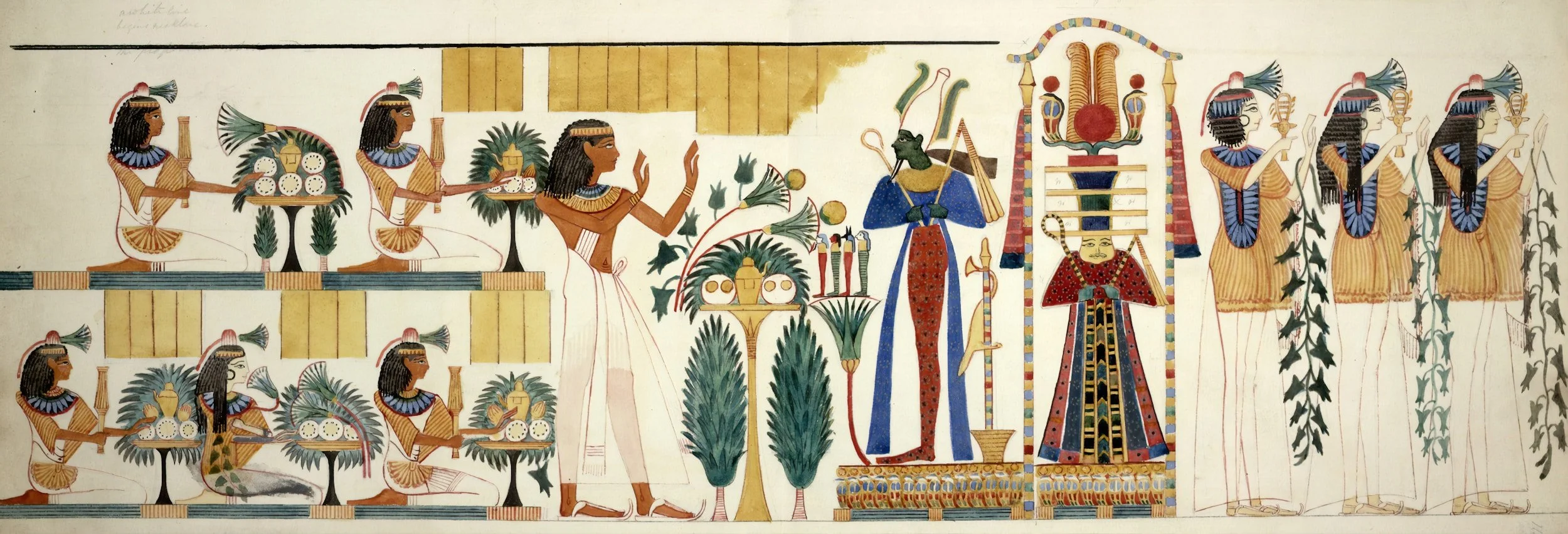
The Archive
(Each entry links to a full informational article exploring origins, symbolism, and cultural role.)
🜂 Kemetian Gods & Goddesses (Netjeru)
The Ordered Powers Who Sustain the Cosmos
Amun — A hidden creator god whose power lies in invisibility and potential rather than form. Amun represents the unseen force behind existence, later merged with Ra as supreme cosmic authority.
Anubis — Guardian of embalming, tombs, and the dead, guiding souls safely through death’s thresholds. He presides over mummification and ensures the integrity of the body for the afterlife.
Aten — The solar disk itself, elevated to singular divine focus during the Amarna period. Aten represents divine light as direct, impersonal, and all-encompassing presence.
Atum — A primordial creator who brings the cosmos into being through self-generation. Atum embodies completeness, closure, and the moment before differentiation.
Bastet — A goddess of protection, pleasure, and domestic harmony, later associated with cats and joyful ferocity. She guards homes and bodies while retaining a dangerous edge when provoked.
Geb — The living earth beneath all things, whose laughter causes earthquakes. Geb represents fertility, inheritance, and the physical foundation of existence.
Hathor — A goddess of love, music, intoxication, and divine motherhood, equally capable of nurturing or annihilating. She embodies joy as a sacred—and volatile—force.
Heka — The divine embodiment of magic itself, understood as a cosmic force rather than illusion. Heka is the power that allows gods and mortals alike to act within reality.
Horus — A sky and kingship god whose struggle against Set defines rightful rule. Horus represents legitimacy, inheritance, and the restoration of order after chaos.
Isis — A goddess of magic, healing, and devotion whose power lies in knowledge and perseverance. Isis embodies the triumph of care, intelligence, and ritual over death itself.
Khnum — A ram-headed creator god who fashions humans on a potter’s wheel. Khnum governs birth, formation, and the shaping of life’s physical form.
Ma'at — The goddess and principle of truth, balance, and cosmic order. Ma’at is not optional—she is the law by which gods, kings, and the dead are judged.
Montu — A falcon-headed god of war and royal ferocity. Montu represents controlled violence in service of divine authority.
Nephthys — A goddess of mourning, protection, and liminal spaces, standing at the edge between life and death. She guards transitions and aids the dead without ruling them.
Nun — The boundless waters of chaos from which creation emerges. Nun is not evil—he is the eternal backdrop against which order must constantly be asserted.
Osiris — God of death, resurrection, and rightful kingship in the afterlife. Osiris represents continuity beyond decay and the promise that order survives death.
Ptah — A creator god who brings reality into being through thought and speech. Ptah embodies craftsmanship, design, and creation as deliberate act.
Ra — The solar god who journeys across the sky by day and through the Duat by night. Ra sustains life through movement, vigilance, and constant confrontation with chaos.
Sekhmet — A lioness goddess of destruction, plague, and divine retribution. Sekhmet represents necessary violence unleashed when Ma’at is threatened.
Set — A god of storms, disruption, and necessary chaos, both adversary and protector. Set embodies force without balance—dangerous, but sometimes indispensable.
Sobek — A crocodile god associated with the Nile, fertility, and raw physical power. Sobek represents nature’s appetite and its capacity to sustain or devour.
Thoth — God of wisdom, writing, measurement, and divine law. Thoth records truth, calculates fate, and ensures that cosmic systems function correctly.
🜁 Divine Families, Households & Cult Centers
Sacred Lineages, Regional Devotion, and Temple Power
Abydos Triad — Centered on Osiris, Isis, and Horus, this cult complex anchors Egyptian beliefs about death, resurrection, and rightful kingship. Abydos functioned as a spiritual gateway to the afterlife, drawing pilgrims for millennia.
Elephantine Triad — Consisting of Khnum, Satet, and Anuket, this household governed the Nile’s inundation and the southern border of Egypt. Their worship tied cosmic order directly to the river’s life-giving flood.
Ennead of Heliopolis — A foundational creation lineage beginning with Atum and unfolding through Shu, Tefnut, Geb, Nut, Osiris, Isis, Set, and Nephthys. This divine family maps the structure of the universe from first creation to mortal consequence.
Hermopolitan Ogdoad — Eight primordial deities representing chaos, darkness, infinity, and hiddenness before creation. The Ogdoad embodies the preconditions of existence rather than creation itself.
Memphite Theology — A theological framework centered on Ptah, who creates through thought and speech. Memphis positioned divine craftsmanship and intellectual order as the highest creative force.
Philae Triad — Focused on Isis, Osiris, and Horus, Philae became one of the last strongholds of traditional Egyptian religion. This cult emphasized magic, devotion, and the persistence of sacred ritual into late antiquity.
Theban Triad — Comprised of Amun, Mut, and Khonsu, this household rose to national prominence during the New Kingdom. Their cult reflects the fusion of political power, temple wealth, and cosmic authority.
Triad of Elephantine — A localized river-based household overseeing fertility, protection, and southern sovereignty. Their worship reinforced Egypt’s dependence on controlled natural cycles.
Triad of Memphis — A powerful divine household balancing creation, destruction, and healing. This triad reflects the belief that order is sustained only through controlled extremes.
🜃 Spirits, Guardians & Liminal Beings
Protectors, Messengers, and Threshold Powers
Aker — A double-lion earth deity who guards the horizon where the sun enters and exits the underworld. Aker represents protection at the threshold between worlds and the stability of the earth itself.
Bennu — A primordial bird spirit associated with creation, renewal, and the soul of Ra. Bennu embodies cyclical rebirth and the moment when order rises from chaos.
Bes — A dwarf-like guardian spirit of households, childbirth, sexuality, and music. Bes protects against malevolent forces through noise, humor, and fierce presence rather than cosmic authority.
Duamutef — One of the Four Sons of Horus, guardian of the stomach and protector of the deceased’s organs. He oversees preservation and ritual integrity in the afterlife.
Hapi — A funerary guardian associated with the lungs and protected by Nephthys. Hapi represents breath, continuity, and safe passage beyond death.
Imsety — A human-headed guardian who protects the liver and is associated with Isis. Imsety embodies care, protection, and moral balance after death.
Medjed — An obscure but striking guardian spirit described as “the smiter,” often depicted as a shrouded, staring figure. Medjed represents unseen protection and sudden divine intervention.
Qebehsenuef — A falcon-headed funerary guardian protecting the intestines, watched over by Selket. He represents purification and safeguarding against corruption.
Shezmu — A liminal being who crushes grapes for wine and enemies alike, serving as both executioner and purifier. Shezmu embodies sacred violence used to uphold divine order.
Taweret — A fearsome hippopotamus-shaped protector of childbirth and domestic life. Taweret guards liminal moments where life is most vulnerable.
Wadjet — A protective cobra spirit associated with kingship and the Eye of Ra. Wadjet defends sacred authority and strikes against threats to order.
🜄 Monsters of Chaos & Cosmic Opposition
Serpents, Beasts, and the Enemies of Order
Apep — The great serpent of chaos who attacks the sun god’s barque each night in the Duat. Apep embodies Isfet in its purest form: uncreation, darkness, and resistance to cosmic order.
Ammit — A fearsome composite beast who consumes the hearts of the unjust after judgment. Ammit is not evil but terminal—representing annihilation rather than punishment.
Apophis (Apep) — The Greek rendering of Apep’s name, reflecting later interpretations of the same cosmic adversary. His presence reinforces that chaos has many names, but one function.
Serpopard — A leopard-serpent hybrid depicted in early dynastic art, symbolizing untamed chaos beyond Egypt’s borders. The serpopard represents disorder that civilization must constrain.
Set (as Adversary) — In his oppositional role, Set functions as internalized chaos: storms, violence, and disruption within the cosmic system. Unlike Apep, Set is dangerous but necessary, holding chaos in tension rather than annihilation.
To study Kemet is to study responsibility.
In Egyptian belief, the universe does not run on faith alone. It runs on action—on offerings made, words spoken correctly, hearts weighed honestly, and chaos held at bay through attention and care. The gods do not simply rule the world; they depend on it to uphold its part of the balance. Even the dead are not finished with their duties.
As you move through this archive, you will encounter gods of radiant order and terrifying necessity, spirits who guard thresholds, monsters who exist to be overcome, and symbols that bind heaven, earth, and the underworld into a single living system. These are not characters meant to entertain. They are forces meant to be understood.
This archive is an invitation to step into a worldview where balance is sacred, memory is power, and nothing—living or dead—exists outside the web of consequence.
The Nile still rises.
The scales are still waiting.