Desert & River Temples
Where gods rose from flood and flame, and order was written into the stars.
This archive gathers the ancient polytheistic traditions born along rivers, deserts, and fertile crescent lands—faiths shaped by flooding cycles, celestial law, temple economies, and priestly knowledge. These religions understood the cosmos as a system of balance: between chaos and order, humanity and the divine, life and the afterlife.
Here, ritual was architecture. Myth was law. Offerings fed gods who governed not only nature, but civilization itself.
What follows are the primary currents of these traditions, each preserved through reconstruction, scholarship, and living devotion.
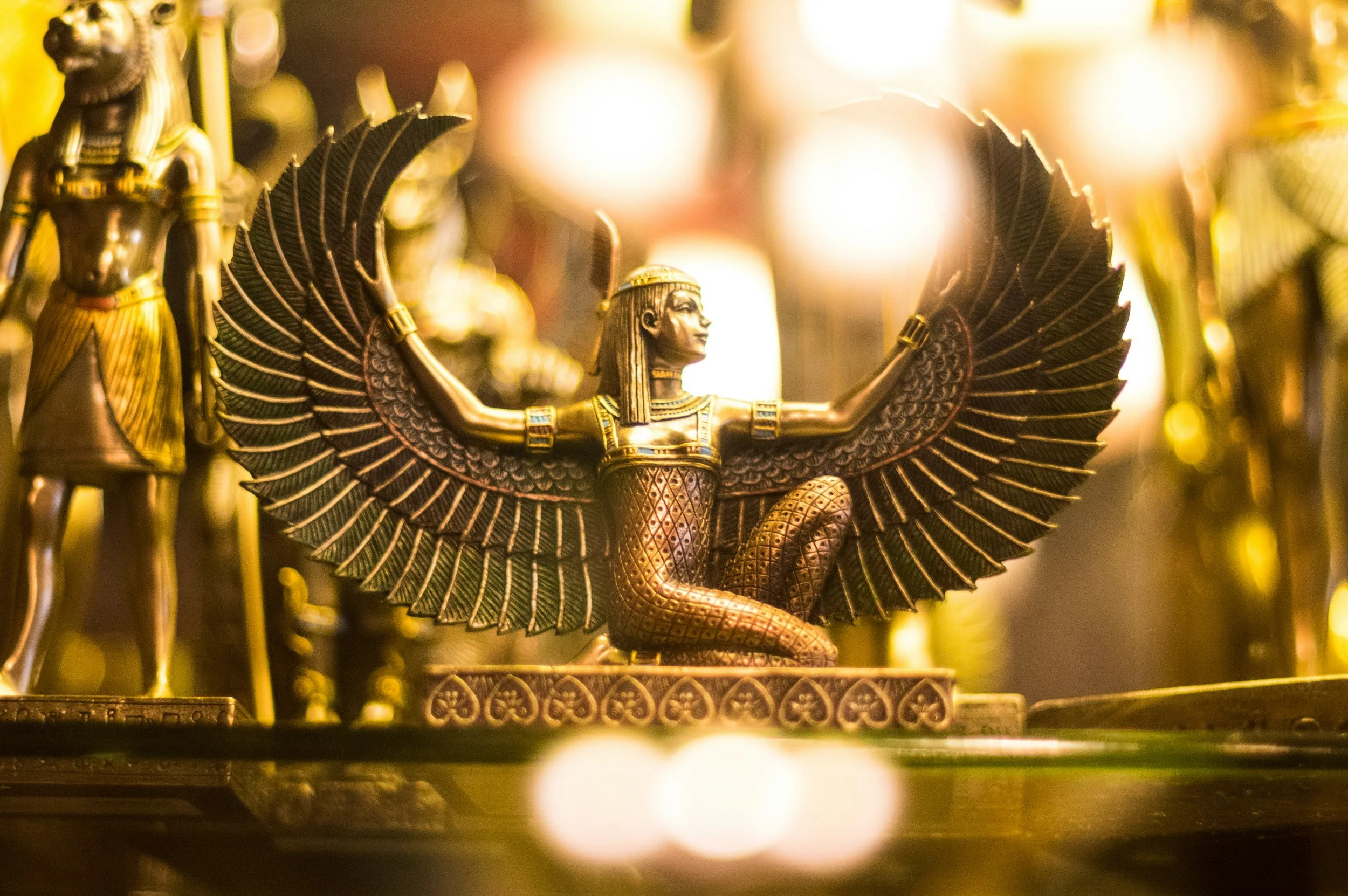
🜂 KEMETISM
Sacred order, eternal return, and the breath of the Netjeru.
Kemetism is the modern revival of ancient Egyptian religion, centered on Ma’at—cosmic balance, truth, and right action. Ritual precision, offerings, and devotional cycles restore relationships with the Netjeru, the gods who sustain the world through harmony.
→ Explore divine order, temple rites, festivals, and rebirth.
Kemetism – Ancient Egyptian Polytheism Reborn — Kemetism is the modern revival of Ancient Egyptian polytheism, honoring Ra, Isis, Osiris, and the pantheon of the Netjeru. Drawing from temple texts, hymns, and festivals, practitioners rebuild rituals of offerings, libations, and seasonal celebrations like Wep Ronpet. Discover how the gods of Egypt live again in a tradition reborn from the sands of time.
Lighthouse of Alexandria: Egypt’s Lost Tower of Flame and Fame — Before GPS, there was Pharos. A colossal lighthouse born of fire and stone, whispering light across the sea and secrets across time.
When Magic Was Medicine: Witchcraft in Ancient Egypt, Greece, and Rome — Long before witches were feared, they were revered healers. Journey through ancient Egypt, Greece, and Rome, where magic intertwined with medicine, rituals soothed the body and soul, and practitioners guarded secrets that blurred the line between science and sorcery.
🜃 MESOPOTAMIAN RECONSTRUCTIONISM
Gods older than writing, cities older than memory.
Mesopotamian Reconstructionism revives the religious traditions of Sumer, Akkad, and Babylon—where gods governed fate, kingship, and catastrophe. These paths are built from cuneiform texts, hymns, omen literature, and ritual calendars tied to the earliest cities.
→ Enter the cradle of civilization and its restless gods.
Hanging Gardens of Babylon: The Vanished Eden in the Sky — A garden in the sky, a queen’s longing, and a mystery that refuses to wilt. The Hanging Gardens bloom in legend—real or not, they live on.
Mesopotamian Reconstructionism – Reviving the Gods of the Cradle of Civilization — Mesopotamian Reconstructionism seeks to revive the ancient worship of Sumerian and Babylonian gods like Inanna, Enlil, and Enki. Drawing from cuneiform texts, hymns, and rituals, practitioners reconstruct offerings, divination, and festivals such as Akitu. Discover how modern pagans reawaken the gods of the world’s first civilization in a faith reborn from ruins.
Mystery Batteries & Electric Past: Baghdad’s Ancient Energy — Beneath the sands of ancient Mesopotamia lies a curious artifact: the Baghdad Battery. Was it an ancient electric cell, a ritual object, or a forgotten medical tool? Its secrets spark debates across archaeology, pop culture, and forums, bridging ancient ingenuity with modern fascination.
🜄 CANAANITE & LEVANTINE TRADITIONS
Storm gods, sea mothers, and sacred conflict.
Canaanite and Levantine traditions honor deities born of drought, thunder, fertility, and war—gods whose myths shaped later religious narratives across the Mediterranean. Reconstruction draws from Ugaritic texts, archaeology, and comparative myth.
→ Discover storm cycles, sacred kingship, and divine rivalry.
Canaanite Reconstructionism – Reviving the Gods of the Levant — Canaanite Reconstructionism revives the ancient gods of the Levant, from Baal and Anat to Asherah and El. Drawing on Ugaritic texts, archaeology, and Biblical echoes, practitioners rebuild lost rituals and seasonal festivals. Explore how modern pagans honor the storm god, the warrior goddess, and the mother of the sea in a faith reborn from ruins.
🜁 COSMOLOGY & PRIESTHOOD
When ritual became technology and myth mapped the universe.
Beyond individual gods, these cultures built vast cosmological systems—calendars, omens, star charts, and ritual offices that aligned humanity with the divine order. Priests were astronomers, healers, judges, and mediators between worlds.
→ Study how ritual structured reality itself.
Clocks Under the Sea: The Antikythera Mechanism’s Renaissance in Pop Culture — Beneath the waves, an ancient bronze device predicted the movements of stars and eclipses. The Antikythera Mechanism, lost for centuries, now captivates modern audiences, from YouTube explainer videos to pop-science fascination, bridging the gap between antiquity and today’s digital wonder.
Colossus of Rhodes: The Sun God’s Bronze Sentinel of Defiance — A towering bronze titan of Helios once guarded Rhodes, a radiant symbol of resilience and sunlit defiance—now lost to time but never forgotten.
Mausoleum at Halicarnassus: The Tomb That Redefined Immortality — A tomb so magnificent it became a legend, the Mausoleum at Halicarnassus was a shimmering fusion of Greek, Egyptian, and Lycian artistry—a lasting tribute to a ruler who refused to be forgotten.
Mystery Batteries & Electric Past: Baghdad’s Ancient Energy — Beneath the sands of ancient Mesopotamia lies a curious artifact: the Baghdad Battery. Was it an ancient electric cell, a ritual object, or a forgotten medical tool? Its secrets spark debates across archaeology, pop culture, and forums, bridging ancient ingenuity with modern fascination.
Statue of Zeus at Olympia: The Golden Majesty Lost to Time — A throne of gold and ivory, a god’s gaze carved in eternal majesty—Zeus’s statue at Olympia still sparks wonder in the hearts of those who dare to imagine.
Temple of Artemis at Ephesus: The Moonlit Marvel Lost to Time — A temple of moonlight and marble, Artemis’s sanctuary at Ephesus still breathes secrets through crumbling columns and whispered legends.
If you sense a temple left unmarked—a god forgotten beneath sand, a ritual hinted at in broken text, a constellation still whispering its old name—leave us a note below and help expand the living archive.
If you’d like to support the work behind these temples, you can leave an offering on Ko-fi. Every contribution keeps the lamps lit and the records growing.
For deeper research, source-driven essays, and long-form explorations of ancient cosmology and priesthood, join us on Patreon—where the work is slow, deliberate, and always done by firelight.
However you arrived—through history, mystery, or sheer curiosity—you are welcome here. Walk the temple courts, listen for the echo of chants, and remember: the gods of these lands never truly vanished. They learned to wait.